 Fonti
FontiYour Brand Name
Hello World
Type Jam Doughnut into the box below. The Flipped card returns ſɐɯ ◖onƃɥunʇ, while the Upside Down card returns ʇnuɥƃno◖ ɯɐſ. Copy either result, paste it into an Instagram bio or a Discord message, and it stays flipped. No screenshot, no image, no app.
Style: Bold Script
Your Brand Name
Hello World
Hello World
Hello World
No favourites yet. Tap the star on a card to save it.
Nothing copied yet.
Nothing matches that search.
Numbers stay plain.
characters
Pick an alphabet, a separator and a decoration, then copy the result.
Live preview
0 units
Ⅎʃıddǝp
Some capitals and digits 2, 3, 4 and 7 use borrowed characters, so their appearance can vary by device. Digits 1 and 5 stay plain. This card does not reverse the line.
uʍo◖ ǝpısd∩
Some capitals and digits 2, 3, 4 and 7 use borrowed characters, so their appearance can vary by device. Digits 1 and 5 stay plain. The text is reversed so it reads when the page is turned upside down.
Marks added over your text, letters unchanged.
An alphabet wrapped in a decoration.
Decoration wrapped around your text, letters unchanged.
Decoration wrapped around your text, letters unchanged.
Decoration wrapped around your text, letters unchanged.
Decoration wrapped around your text, letters unchanged.
Decoration wrapped around your text, letters unchanged.
Decoration wrapped around your text, letters unchanged.
Now look at the spot where the capital D should be. That half-filled circle is not a letter. It is a shape from a completely different corner of Unicode, standing in because nobody ever created an upside-down D.
Gaps like that run through the whole alphabet, and most pages about flipped text walk straight past them. This one lists them. Every flipped character and where it came from, which ones turn into empty boxes on a real phone, the two digits that have no flipped form at all, and why the upside down question mark and exclamation mark you might be searching for belong to a different subject entirely.
Drop your words into the box at the top of this page. The output updates as you type, so you can watch a name or a bio line change character by character. Nothing is uploaded anywhere; the swap happens inside your browser.
These two settings do different jobs and the difference matters more than it looks. Flipped swaps each character for one that resembles its turned version but keeps the reading order, so Jam Doughnut becomes ſɐɯ ◖onƃɥunʇ. Flipped and reversed also runs the whole line backwards, giving ʇnuɥƃno◖ ɯɐſ, which is what you want if you are trying to look like the text has been rotated on the page.
Most people want the second one. The first is useful when you need each word to stay in place, such as a list or a set of tags.
Use the copy button rather than selecting the text by hand. Several of these characters sit outside the usual Latin range, and a manual drag can clip the last one without you noticing.
This is the step every other flipped-text page leaves out, and it is the one that saves you. Paste your line into the app you actually plan to use, on the device you actually plan to use, and read it back. Capital letters and digits are where this breaks, and you would rather find that out now than after two hundred people have seen a row of empty rectangles in your bio.
Three words get used as if they mean the same thing, and they do not. Unicode itself is precise about this, and the precision is built into the names of the characters. Once you know which word means what, half the tools online start making more sense.
| Unicode’s word | What was done to the letter | Example | What people call it |
|---|---|---|---|
| Turned | Rotated 180 degrees | ɐ TURNED A |
Upside down, flipped |
| Reversed | Reflected across a vertical line | ǝ TURNED E’s cousin Ǝ REVERSED E |
Mirrored |
| Inverted | Reflected across a horizontal line | very few exist | rarely used by anyone |
| Sideways | Rotated 90 degrees | a handful of vowels | almost never supported |
Unicode does not contain a complete upside-down alphabet. This tool therefore mixes genuinely turned letters with reversed letters, mathematical operators, characters borrowed from other writing systems and unchanged characters that already have a useful shape. The official Unicode name in each row shows what each substitute actually is.
Worth knowing: the phrase inverted text generator gets searched constantly, and in Unicode’s own vocabulary it means the wrong thing. Inverted is a vertical flip, not a rotation. Nearly everyone typing that phrase wants turned characters, so tools quietly treat the two words as synonyms and nobody corrects it.
Mirrored text is a genuinely separate set. It uses reversed characters, and it reads correctly when you hold it up to an actual mirror. Here is the blunt version: most sites that advertise a mirror tool do not mirror anything.
They reverse the order of your letters and leave the letters themselves facing the right way, which produces backwards word order rather than a reflection. If a tool turns hello into olleh, that is reversed order. If it turns it into shapes that lean the other way, that is mirroring. Small text and subscript are a fourth thing again, built from a completely different set of blocks, and our small text generator covers that set properly.
Here is the full mapping, all 26 alphabet letters in both cases. The last column is the one no other page shows you, and it explains almost everything that goes wrong later. Read it once and the compatibility problems further down stop being a mystery.
| Letter | Flipped | Code point | Real name | Comes from |
|---|---|---|---|---|
| a | ɐ |
U+0250 | TURNED A | IPA Extensions |
| b | q |
U+0071 | SMALL LETTER Q | Basic Latin |
| c | ɔ |
U+0254 | OPEN O | IPA Extensions |
| d | p |
U+0070 | SMALL LETTER P | Basic Latin |
| e | ǝ |
U+01DD | TURNED E | Latin Extended-B |
| f | ɟ |
U+025F | DOTLESS J WITH STROKE | IPA Extensions |
| g | ƃ |
U+0183 | B WITH TOPBAR | Latin Extended-B |
| h | ɥ |
U+0265 | TURNED H | IPA Extensions |
| i | ı |
U+0131 | DOTLESS I | Latin Extended-A |
| j | ɾ |
U+027E | R WITH FISHHOOK | IPA Extensions |
| k | ʞ |
U+029E | TURNED K | IPA Extensions |
| l | ʃ |
U+0283 | ESH | IPA Extensions |
| m | ɯ |
U+026F | TURNED M | IPA Extensions |
| n | u |
U+0075 | SMALL LETTER U | Basic Latin |
| o | o |
— | unchanged | — |
| p | d |
U+0064 | SMALL LETTER D | Basic Latin |
| q | b |
U+0062 | SMALL LETTER B | Basic Latin |
| r | ɹ |
U+0279 | TURNED R | IPA Extensions |
| s | s |
— | unchanged | — |
| t | ʇ |
U+0287 | TURNED T | IPA Extensions |
| u | n |
U+006E | SMALL LETTER N | Basic Latin |
| v | ʌ |
U+028C | TURNED V | IPA Extensions |
| w | ʍ |
U+028D | TURNED W | IPA Extensions |
| x | x |
— | unchanged | — |
| y | ʎ |
U+028E | TURNED Y | IPA Extensions |
| z | z |
— | unchanged | — |
Lowercase is the healthy half. Most of it comes from the International Phonetic Alphabet, the set linguists use to write down the sounds of human speech. Those characters were added decades ago and they ship inside almost every system font, which is why lowercase flipped text almost never breaks.
One letter in that table needs flagging. The flipped g is ƃ, a character from the old Zhuang orthography, and several popular tools substitute ɓ instead. They look similar at a glance and they are not the same letter. If your flipped g ever looks slightly wrong next to someone else’s, that is why.
| Letter | Flipped | Code point | Real name | Comes from |
|---|---|---|---|---|
| A | ∀ |
U+2200 | FOR ALL | Mathematical Operators |
| B | ᗺ |
U+15FA | CANADIAN SYLLABICS CARRIER KHA | Unified Canadian Aboriginal Syllabics |
| C | Ↄ |
U+2183 | ROMAN NUMERAL REVERSED ONE HUNDRED | Number Forms |
| D | ◖ |
U+25D6 | LEFT HALF BLACK CIRCLE | Geometric Shapes |
| E | Ǝ |
U+018E | REVERSED E | Latin Extended-B |
| F | Ⅎ |
U+2132 | TURNED CAPITAL F | Letterlike Symbols |
| G | ⅁ |
U+2141 | TURNED SANS-SERIF CAPITAL G | Letterlike Symbols |
| H | H |
— | unchanged | — |
| I | I |
— | unchanged | — |
| J | ſ |
U+017F | LONG S | Latin Extended-A |
| K | ⋊ |
U+22CA | RIGHT NORMAL FACTOR SEMIDIRECT PRODUCT | Mathematical Operators |
| L | ⅂ |
U+2142 | TURNED SANS-SERIF CAPITAL L | Letterlike Symbols |
| M | W |
U+0057 | CAPITAL W | Basic Latin |
| N | ᴎ |
U+1D0E | SMALL CAPITAL REVERSED N | Phonetic Extensions |
| O | O |
— | unchanged | — |
| P | Ԁ |
U+0500 | CYRILLIC CAPITAL KOMI DE | Cyrillic Supplement |
| Q | Ό |
U+038C | GREEK CAPITAL OMICRON WITH TONOS | Greek |
| R | ᴚ |
U+1D1A | SMALL CAPITAL TURNED R | Phonetic Extensions |
| S | S |
— | unchanged | — |
| T | ⊥ |
U+22A5 | UP TACK | Mathematical Operators |
| U | ∩ |
U+2229 | INTERSECTION | Mathematical Operators |
| V | ᴧ |
U+1D27 | GREEK LETTER SMALL CAPITAL LAMDA | Phonetic Extensions |
| W | M |
U+004D | CAPITAL M | Basic Latin |
| X | X |
— | unchanged | — |
| Y | ⅄ |
U+2144 | TURNED SANS-SERIF CAPITAL Y | Letterlike Symbols |
| Z | Z |
— | unchanged | — |
Read that last column again. Four of those capitals are maths symbols doing an impression of a letter. ∀ is the logic sign meaning for all, ⊥ is an up tack, ∩ means intersection, and ⋊ has a name so long it barely fits in the table. And the flipped D is not even pretending to be a letter. It is half of a filled circle.
The rest is a tour through unrelated writing systems. Ԁ is Cyrillic, Ό is Greek, and ᗺ is Canadian syllabics, officially CANADIAN SYLLABICS CARRIER KHA.
Ⅎ traces back to a letter the Roman emperor Claudius tried to add to Latin. ſ is the long s, the character that makes eighteenth-century printing look like it says houfe instead of house. The live map draws from fourteen Unicode blocks, including Latin, phonetic, mathematical, geometric and syllabic ranges.
Three capitals sit in an awkward middle. ᴎ, ᴚ and ᴧ are small capitals, so they render perfectly well but come out shorter than the capitals around them. Nothing is broken, the line just looks slightly uneven.
The Lisu block, historically associated with the Fraser alphabet, was added in Unicode 5.2 in October 2009. This tool does not use Lisu characters, and Unicode still does not provide a complete upside-down capital alphabet.
Digits are the weakest part of flipped text by a wide margin, and no other page will tell you so. The table below is the honest version. It includes the two digits that have no flipped form at all.
| Digit | What you get | Is there a genuine turned character? | What is going on |
|---|---|---|---|
| 0 | 0 |
Not needed | Symmetrical, reads the same either way |
| 1 | 1 |
None exists | Nothing in Unicode resembles a turned one |
| 2 | ᘔ |
Previous mapping only, U+218A TURNED DIGIT TWO | Live output is ᘔ, U+1614 CANADIAN SYLLABICS CARRIER JU, a borrowed substitute |
| 3 | Ɛ |
Previous mapping only, U+218B TURNED DIGIT THREE | Live output is Ɛ, U+0190 LATIN CAPITAL LETTER OPEN E, a borrowed substitute |
| 4 | ᔭ |
None exists | ᔭ is U+152D CANADIAN SYLLABICS YA, a borrowed visual substitute |
| 5 | 5 |
None exists | Nothing in Unicode resembles a turned five |
| 6 | 9 |
Pairs with 9 | The two digits already flip into each other |
| 7 | Ɫ |
No | An L with a middle tilde, borrowed |
| 8 | 8 |
Not needed | Symmetrical |
| 9 | 6 |
Pairs with 6 | The pair again, running the other way |
Two digits have nothing at all. Zero and eight are symmetrical so they need no partner, six and nine already turn into each other, and the rest are patched with borrowed characters. That leaves a set which works properly for about half of what you type.
The two and the three are the interesting case. Genuine turned versions of both do exist, ↊ and ↋, and they sit in the Number Forms block alongside the Roman numerals. They were the previous mapping, added in Unicode 8.0 in 2015 for duodecimal arithmetic, a base-twelve counting system, where they stand in for ten and eleven. Bio decoration was never the point. The live tool no longer emits them, and what you get now is ᘔ for two and Ɛ for three, borrowed visual substitutes that another phone may still fail to draw.
There is a neat reason the one and the five were never solved. On a seven-segment display, the kind in a pocket calculator, an upside-down two is indistinguishable from a five. The shapes collide, so no separate character was ever worth designing.
Quick note on the four: the person who wrote the character mapping that almost every generator on the web copied left a comment admitting it was the weakest entry in the table. That admission has been sitting in public for years while the rest of the internet reused the map anyway. Nobody has fixed it since. No encoded turned digit four exists, so the live four is ᔭ, U+152D CANADIAN SYLLABICS YA, a borrowed visual substitute.
So Jam Doughnut 45 comes out as 5ᔭ ʇnuɥƃno◖ ɯɐſ. The four turns into a syllabics character that only half resembles it, and the five stays stubbornly upright. There is no honest way around that. If you want digits that genuinely change shape, our number font generator carries proper styled sets built for the job.
No rotation happens anywhere in this process. Your phone does not turn anything over, and no image is generated at any point. What happens is a lookup. The tool holds a table with one row per character, reads your text one character at a time, and swaps each one for a different character that already existed in Unicode long before anyone thought of using it this way. Then, if you picked the reversed setting, it reads the whole line backwards.
The clearest proof sits in your own name. When your n appears to flip, you are not looking at a rotated n. You are looking at a u, an ordinary letter that has been in every font since fonts began, which happens to look like an upside-down n. The same trick runs the other way with b and q, and with d and p.
Everything else is the same trick with less convenient source material. There is no letter that resembles a rotated a, so the table reaches into the phonetic alphabet and borrows ɐ, a symbol linguists use for a specific vowel sound. There is nothing that resembles a rotated capital A, so it reaches into mathematics and takes ∀.
This is why the effect behaves so unevenly. A font that ships with the phonetic block will render your lowercase perfectly and still fail on a maths operator, because those characters live in different parts of the standard and get supported at different times by different devices. It is also why flipped text can be copied, pasted, saved and searched as ordinary text while still looking like a picture of upside down writing. Every one of those symbols is a real, individually numbered character with a name and a purpose. The purpose just has nothing to do with being upside down.
Whether flipped text survives depends less on the app and more on the specific box you paste it into. The same platform will accept it in one field and reject it in another. The list below goes through them one at a time.
Instagram Bio was one of the fields tested on a Redmi A2+ running Android 13. The live substitutes rendered there without empty boxes. iPhone remains untested. Keep the flipped portion short, because a whole bio of turned letters is genuinely hard to read.
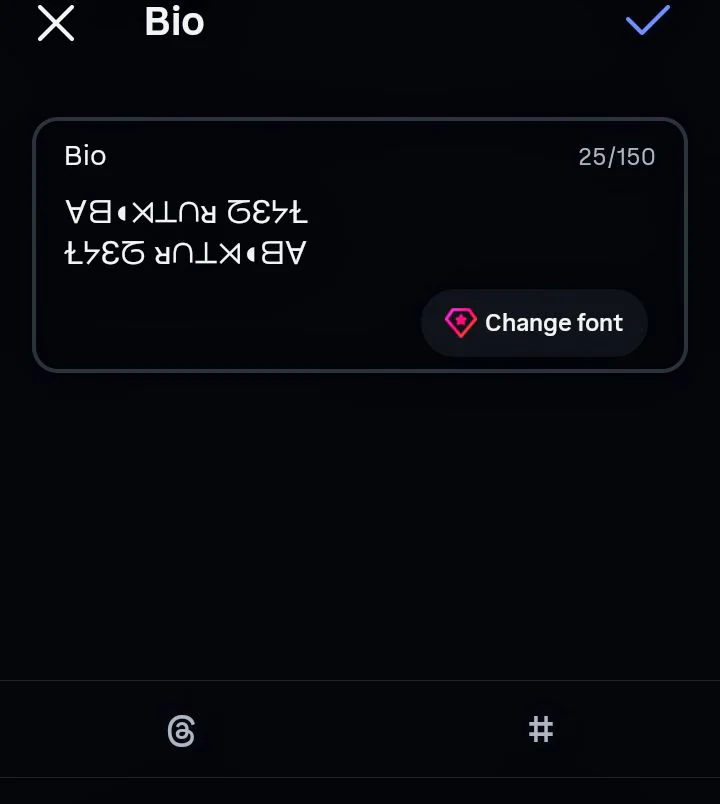
Both flipped modes pasted into the Instagram bio field on a Redmi A2+. The 25 characters counted against the 150-character limit, and no empty boxes appeared.
Your name field is the one under your username, and it holds 64 characters rather than the 30 that most of the internet still reports. The limit was raised in June 2022. Before you flip it, know that this field is searched. Instagram matches your name against what people type into the search bar, so replacing it with turned characters removes you from those results. Head to our Instagram fonts page for the fields where styling is safe.
Not possible. Usernames accept letters, numbers, periods and underscores, and nothing outside that set is allowed. There is no workaround for it.
Both work. Captions run to 2,200 characters, so a flipped opening line followed by normal text is a common pattern and reads far better than flipping the lot. Comments behave the same way.
Works well, and this is where the prank use actually lives. A flipped status looks like a rendering fault, which is the joke. It is also the fastest way to get a message screenshotted and sent back to you with a question mark.
Display names accept full Unicode, so an upside down name works fine there. Usernames changed in 2023 and now allow only lowercase letters, numbers, underscores and periods, so those are closed to you. Messages, channel topics and server nicknames all accept it. Try our Discord fonts page for the fuller picture of what survives inside a server.
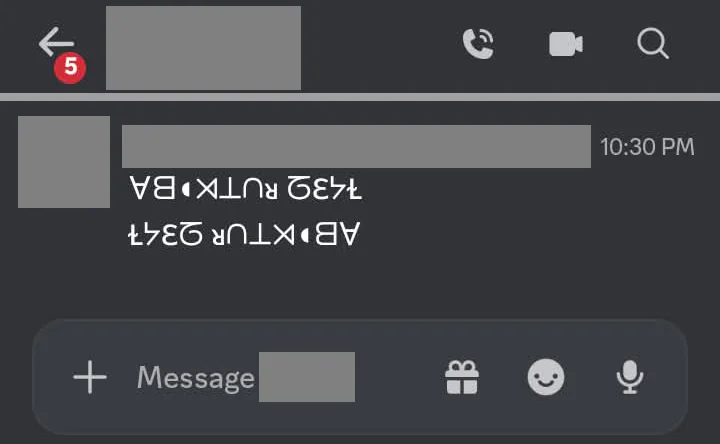
Both flipped modes sent in a Discord message on a Redmi A2+. The replacement characters remained visible after sending.
Technically possible in posts and comments, awkward everywhere else. Name changes lock for 60 days once made, which is a long time to live with a mistake, and page names are reviewed. Fair warning if you run ads: Meta’s advertising policy explicitly prohibits using Unicode characters or symbols in ad text to obfuscate words or phrases. In an ad, flipped text becomes a policy problem.
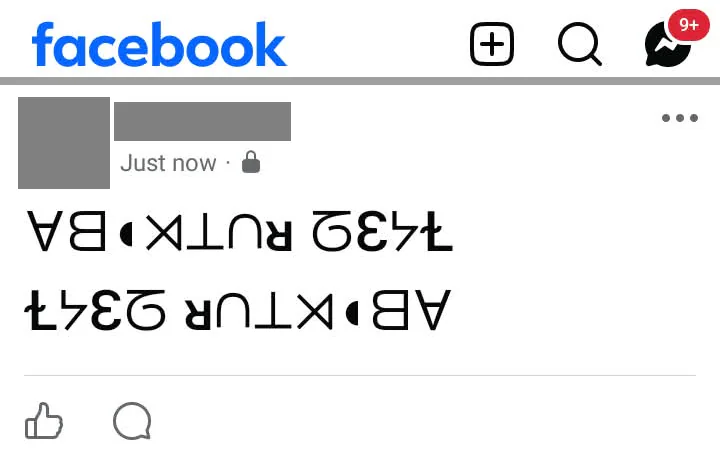
Both flipped modes posted privately on Facebook from a Redmi A2+. The replacement characters rendered without empty boxes.
The empty rectangle you sometimes see has a name. Typographers call it tofu, because a hollow box looks like a block of it, and Google named its Noto font family after the goal of having no tofu left anywhere. Tofu appears when your device has the character but the font in front of you has no drawing for it.
The usual explanation gets this backwards. Your text arrived intact and the character is present; the font in front of you just has no picture to draw, so the system puts a placeholder box there instead.
Which characters break follows directly from the source column in the chart above. The failures are not random. You can predict every one of them.
| Risk level | Characters | Why |
|---|---|---|
| Safe almost everywhere | All lowercase turned letters | Phonetic alphabet characters ship in nearly every system font |
| Renders, can sit uneven | ᴎ ᴚ ᴧ |
Small capitals, so they can sit shorter than the capitals beside them |
| Usually fine, worth a check | ∀ ⊥ ∩ ⋊ |
Maths operators live in maths fonts, and not every app loads one |
| Tested replacements | ᗺ ᘔ Ɛ |
Rendered without empty boxes in Chrome, WhatsApp, Instagram, Discord and Facebook on a Redmi A2+ running Android 13 |
We tested the previous mapping and the live one, rather than guessing. On an Infinix Note 7, the previous 𐐒 and four tested mathematical operators rendered in WhatsApp, Chrome and the Instagram bio, while the previous ↊ and ↋ appeared as boxes. On a Redmi A2+ running Android 13, that same previous 𐐒 rendered, while ↊ and ↋ appeared as boxes in Chrome, WhatsApp and Instagram.
The live ᗺ, ᘔ and Ɛ then rendered on that Redmi in production Chrome, WhatsApp, the Instagram bio, a sent Discord message and a private Facebook post. That is one handset and those apps only. iPhone remains untested, and none of this is a promise that every phone will draw the same characters.
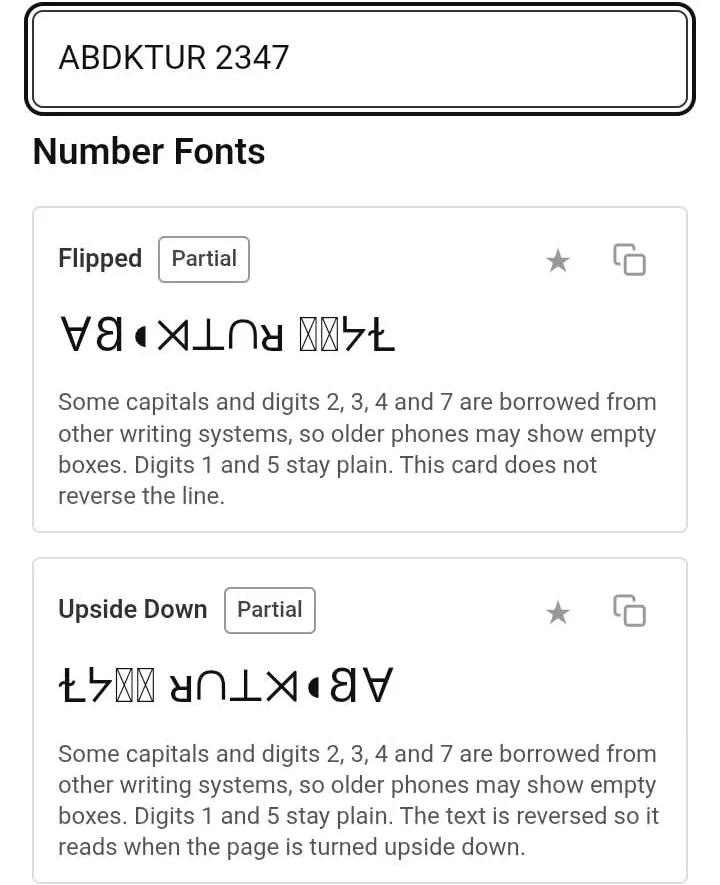
The previous mapping on the Redmi A2+. Capital B rendered, while digits 2 and 3 appeared as empty boxes.
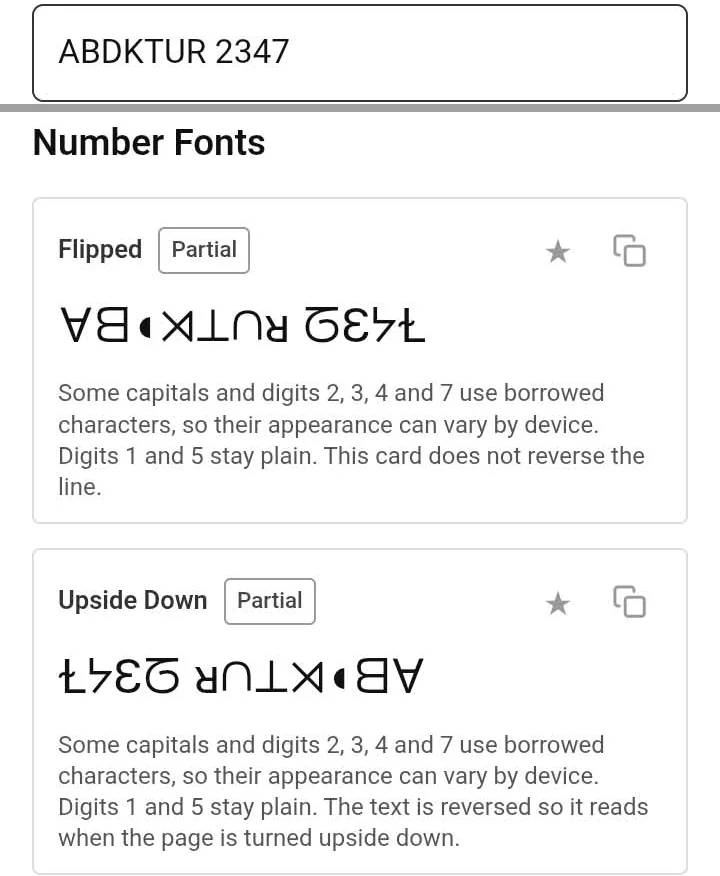
The live mapping on the same Redmi A2+. The replacement characters for B, 2 and 3 all rendered.
People can read flipped text with a bit of effort. Software has a harder time, and it fails in ways that matter. Three of those failures show up often enough to plan around.
Platform search engines match the characters you typed, not the characters they resemble. A flipped name is stored as a string of phonetic and mathematical symbols, so a person typing your actual name will not match it. This applies to Instagram search, Facebook search, Discord member lists and the search box inside almost every app you use.
Good to know: this cuts both ways. If you want to be findable, keep your searchable fields in plain characters. If you want a caption to look unusual and you do not care about being found through it, flipped text costs you nothing.
Screen readers encounter the actual Unicode characters, not the shapes they resemble. Because this map mixes phonetic letters, mathematical operators and characters from other scripts, pronunciation can vary by reader, browser, language and settings. VoiceOver, TalkBack, NVDA and JAWS were not tested in this round, so do not use flipped text for essential information.
You will find pages claiming flipped text provides basic data encryption and suggesting it for sensitive information. That claim is false and worth stating plainly. Here is why it does not hold up.
Flipped text is not encryption. This tool does not reliably decode its own output when you paste it back, because many substitutions are one-way. The public mapping is still predictable and offers no protection for sensitive information.
Here is the section most generator pages bury at the bottom, if they include it at all. When you are working inside software that has real formatting, that software will do this better than we can. Rotating an actual text box gives you all 26 letters, every digit, correct capitals, no boxes on anyone’s device, and text that remains fully searchable and readable by assistive software. Character substitution exists for the places that forbid formatting, such as a bio field or a chat message, and that is the whole of its job.
transform: rotate(180deg); in CSS rotates the element and leaves the underlying text intact for search engines and screen readers.Reality check: if you are designing a poster, a document or a web page, that last line is the correct answer and this page’s tool is the wrong one. Use the tool above for the boxes where you have no other option.
A lot of people arrive here wanting the upside down question mark ¿ or the reverse exclamation mark ¡, and those two are a separate subject with a separate answer.
They are Spanish punctuation. Spanish needs them because a question and a statement can use identical word order, so without an opening mark you do not know a sentence is a question until you reach the end of it. Compare Te gusta el verano with ¿Te gusta el verano? The Real Academia Española recommended the inverted marks in 1754, in the second edition of its orthography, and they have been standard ever since. Not every language that borrowed Spanish conventions agreed; Catalan’s language authority instructs writers never to use them, and Pablo Neruda refused them outright.
You do not need a generator for these. Your keyboard already has them.
| Where you are | ¿ |
¡ |
|---|---|---|
| Windows, any app | Alt + 0191 | Alt + 0161 |
| Microsoft Word | type 00BF then Alt + X |
type 00A1 then Alt + X |
| Mac | Shift + Option + ? | Option + 1 |
| iPhone or Android | hold the ? or ! key |
hold the ! key |
| Spanish keyboard layout | the key to the right of 0 |
same key with Shift |
Now the part that connects this back to the rest of the page. Both characters do appear in the live mapping, and they are the only two entries in the entire set that belong there by design. Somebody sat down and drew an upside-down question mark on purpose, because a language needed one. Every other character in that chart is a coincidence, a letter from Canadian syllabics or Cyrillic or the phonetic alphabet that happens to look right when you squint. Two deliberate marks, and two dozen accidents.
ƃ for the lowercase g, which several widely used tools get wrong.Browse the full collection on our font generator homepage if you want something that stays readable.
Because they already look the same upside down. H, I, O, S, X and Z are close to symmetrical when rotated, and lowercase o, s, x and z behave the same way. The tool had no reason to swap them.
An empty box means the app’s font has no drawing for one of the Unicode characters. Support varies by device and app. On the tested Redmi A2+, the live ᗺ, ᘔ and Ɛ rendered in Chrome, WhatsApp, Instagram, Discord and Facebook, but that does not guarantee every device will draw them.
Yes, the bio is the safest field on the platform for it. Avoid the name field if you want people to find you by searching, since that field is matched against search queries and turned characters will not match.
No. Search inside apps matches the actual characters, and flipped text is made of completely different characters from the ones it resembles. Anything you flip becomes effectively invisible to that app's search.
No. A font changes how your existing letters are drawn, whereas this swaps each letter for a different character that already existed. That is why it survives copy and paste into apps that offer no formatting at all.
Alt + 0191 on Windows, Shift + Option + ? on a Mac, or hold the question mark key on a phone keyboard. You do not need a generator for it. The characters are ¿ U+00BF and ¡ U+00A1, the reverse exclamation mark, and both sit on the same keys.
Not reliably in this tool. Some character pairs swap both ways, but many borrowed symbols do not map back to the original letter. Keep the original text or use the mapping table to reconstruct it.
The upside-down face usually signals sarcasm, resignation or a joke that is not quite funny. It is a separate emoji character and has nothing to do with flipped text, though the two get used together often.
The inverted cross is traditionally the Cross of Saint Peter, a Christian symbol, though modern pop culture has attached other meanings to it. In Unicode you will find ✝, ☦, ⸸ and ✞. It is a standalone symbol rather than something this tool produces.
A palindrome reads the same forwards and backwards as letters, such as level. An ambigram reads as something when rotated or reflected, which is a visual property rather than a spelling one. Flipped text is closer to an ambigram, done with substitute characters instead of custom lettering.
SOS stays SOS on both cards. SWIMS stays SWIMS only on the Upside Down card; Flipped produces SMIWS. NOON becomes ᴎOOᴎ, so it does not remain unchanged in this tool.